About Wael
Based in Los Angeles, Qatari composer Wael Binali, has created a spectacular classical musical mosaic for television, film and the concert hall. While he has been commissioned to write pieces for remarkable occasions such as the UN’s Climate Change Conference or Doha’s Bid for the 2016 Olympics, Arab Cup and FIFA 2021, he remains one of the very few classical composers from the entire Gulf region. Born and raised in the UK and living in the US, Wael’s approach to music reflects his unique upbringing and his eclectic tastes.
While he burst onto the international scene after being commissioned to compose “Through Time”, a 17 minute piece for the opening ceremonies of the 2006 Asian Games, Wael had already established himself as a dynamic young composer. He has worked with award-winning composers, such as Christopher Young on the 2001 Golden Globe-nominated score for the major motion picture The Shipping News, as well as scores for The Runaway Jury, Something The Lord Made, and An Unfinished Life.
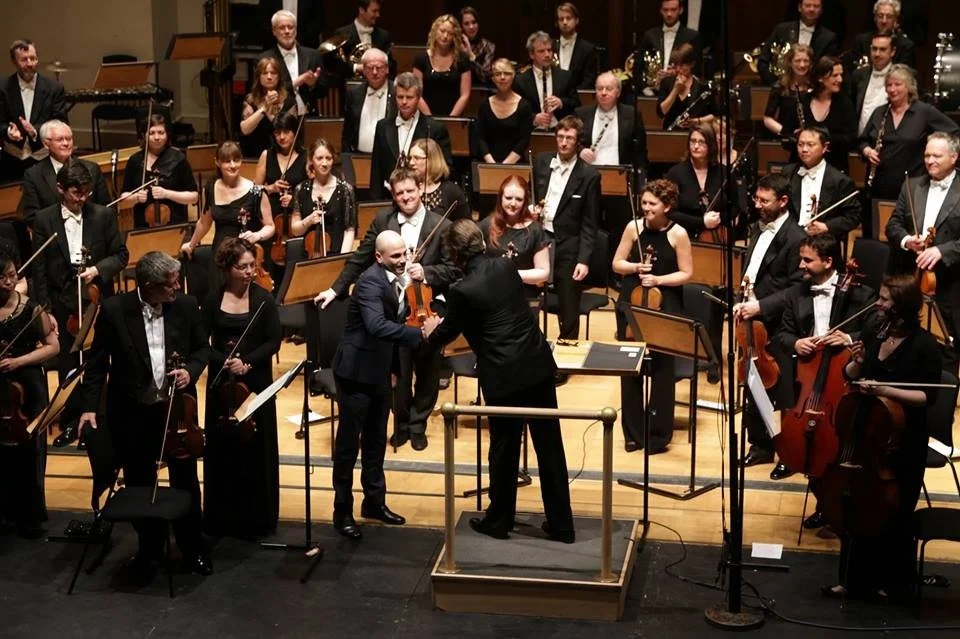
Although Wael has called California his home and his muse for several years, he draws inspiration from his international heritage, Qatari father, Lebanese mother and British upbringing. The 2006 the Asian Games were broadcast worldwide and are widely considered to be the most successful–and sophisticated–Asian Games to date. He has three times been commissioned to write major pieces for the Shafallah Center, an incredible facility for children with special needs organized under the patronage of Her Highness Sheikha Mozah Bint Nasser: “Shafallah” (2006) inspired by the children and dedicated to her highness, followed by “Olive Moon” (2007) and “The Oryx and the Unicorn” (2011). 2008 saw him composing the score to Doha's video bid for the 2016 Olympic games and in 2012 he was commissioned to write a piece for the united nations COP 18 climate change conference titled “Earth". Since then he has written many new works, most notably a piece entitled “Niramaya” for a concert commemorating the 30th anniversary of the Commericial Bank of Qatar, the main title for a major tv show, “Medinah”, the waltz, “La Lola”, for the Alma Orchestra in Paris and a commission for Russia, “The Death of Koschei the Deathless”, based on a Russian fairy tale, in 2019. Wael’s music is being recorded and played worldwide by various orchestras notably the Royal Philharmonic Orchestra, the Royal Scottish National Orchestra, The Alma Orchestra, The Michigan Philharmonic, The Qatar Philharmonic Orchestra and The Philharmonia Orchestra.
Wael credits his father in having unknowingly started him off on his musical journey, having grown up in Qatar till age 11, he was raised on a huge library of great movies from the golden age of Hollywood and some of his earliest influences from that time being movies scored by greats such as Erich Wolfgang Korngold (Captain Blood, The Sea Hawk); Max Steiner (Now Voyager, Gone with the Wind); Franz Waxman (Bride of Frankenstein) and David Raksin (Forever Amber, Laura) the latter who he actually also studied under during his post graduate at University of Southern California. Later on he fell in love with the writing of John Williams (Star Wars, Indiana Jones, ET)
Having also been brought up on Ballet, Classical and Opera, his other major influences started with his first love, Tchaikovsky’s Swan Lake ballet. From there he became heavily influenced by the great Romantics and Impressionists. Namely Richard Strauss, Rimsky-Korsakoff, Stravinsky, Ravel, Debussy, Walton, Rachmaninoff, Takemitsu, Holst, Elgar and Vaughan Williams. And though Wael writes in the classical medium, usually for large scale orchestra, his love of Arabic rhythms and precision sees him infusing those influences into this work whenever appropriate and continues to hone and develop his unique sound.
Wael started his music training in Scotland at Aberlour House and Gordonstoun School as an oboist under the tutelage of Miss Marjorie Downward. After Graduating from Gordonstoun he was offered a scholarship to play oboe and moved to California to begin his training as a composer at Pepperdine University in Malibu, where he studied Theory and Music Composition and graduated with a B.A. in Music History. His post-graduate experience is marked by his close work with many established composers. He trained at the University of California, Los Angeles with composer Mark Carlson, shortly after which he received his first post-graduate degree in Classical Composition at Trinity College of Music in London under the tutelage of British composers Andrew Lovett and Daryl Runswick. While completing his second post-graduate degree, Wael studied under Christopher Young, the fore mentioned David Raksin, Elmer Bernstein, and Leonard Rosenman at the University of Southern California Film Scoring program in Los Angeles.
In his own words “I never knew, even at an early age, why there were no classical composers from the Middle East. Or none that were big enough to be heard of. In fact the art world on the whole was not really established or nurtured as of yet. We have beautiful song writers and composers of Arabic music, but none that wrote classical. It was a bit of a blow growing up not having someone from my own region to look up to, and being drawn into the world, I wanted to be that person whom hopefully others would eventually look up to and say, we also have a classical composer, and hopefully in the end there will be many of us and we end up on that pedestal like the rest of the world. We as Arabs can do what everyone else does. It just takes parents like mine, who see the talent and push their children to achieve what was once thought not possible to achieve or in many eyes, not worth going for. What people do not understand is that most people can be businessmen and women, however, not many can be composers and artists, it is truly a talent that the few who possess have to be pushed to mature and achieve that level of said art. It is also the medium of art that makes us grow as a nation. It makes us see the differences of people as beautiful and make our humanity grow to protect those differences and protect the environment and the animal kingdom for the Earth is fragile and every animal has it’s place in it. Because through art, we realize the beauty and love and develop a greater understanding of the human condition”.